Type: First Italian video game console
Place of origin: Zanussi Research and Development Department, Pordenone
Key figures: Dino Masili, Lorenzo Plos, Luigi Ret, Horst Hillberger
Commercial period: 1974–1979
Country of origin: Italy
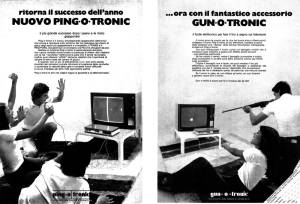
Zanussi, a proud name in Italian electronics
A four-page spread from a 1974 issue of Topolino made the kids of the time dream — kids who are now respectable fifty-somethings!
Excerpt from the original patent registration document for “Improvements to electrical circuits for generating special effects in symbol display systems on a cathode-ray tube, particularly for television games” (IT1018380B, July 23, 1974).
Zanussi’s Ping-O-Tronic holds a special place in video game history. It was the first commercial console ever made in Italy, and among the first in Europe.
Let’s dive into its story. It’s 1972: the success of Magnavox Odyssey in American homes and ATARI PONG in arcades shows that the newly born video game industry is about to explode — not only in the U.S. but also in Europe, where television had by then become a household staple across all social classes. The opportunity was too big to ignore.
One of the first European brands to jump in was the Italian electronics giant Zanussi, already well-known for its quality household systems. Founded in 1916 as Officina Fumisteria Antonio Zanussi in Pordenone, the company began by producing wood-burning stoves, later expanding into brands still known today like Rex and Seleco. Over the decades, Zanussi supplied the military during World War II, created the first portable gas cookers, and later, semi-automatic washing machines for barracks and private homes.
By the 1960s, Zanussi entered the television market, becoming a leader in home appliances by the 1970s. From its prolific Research and Development Department came a visionary project inspired by Magnavox Odyssey and ATARI PONG. Headed by engineer Dino Masili (R&D Director from 1969 to 1984), alongside Lorenzo Plos, Luigi Ret, and Horst Hillberger, the project led to what would become the Ping-O-Tronic, registered under patent number IT1018380B on July 23, 1974.
Italy’s debut in the home console market
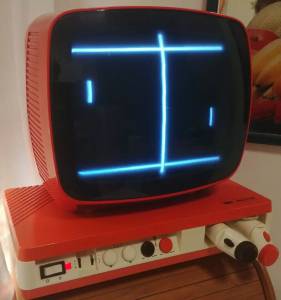
Developed in Zanussi’s R&D lab in Pordenone, the console featured a simple but intriguing design — more mechanical and electronic than computer-based. It had no CPU, using instead a “discrete” circuit made of TTL chips and classic transistors, an affordable solution that allowed a relatively low retail price: 79,000 lire, later discounted to 49,000 lire in some stores like La Rinascente in Rome.
Zanussi launched a major marketing campaign across print, TV, and radio, targeting both adults and kids. Ads appeared in magazines like Topolino, Il Giornalino, and Corriere dei Ragazzi, especially during the Christmas season. In December 1974, the futuristic Ping-O-Tronic became one of the most desired gifts.
The console was an immediate hit — virtually unchallenged in Italy’s home gaming market, except for a few imported competitors like Magnavox Odyssey (branded Odissea in Italy) and the British Videomaster Home TV Game. Some units were also sold under the Seleco brand.
A standout feature was its built-in monophonic speaker, producing sound effects for the games — making Ping-O-Tronic the first console in history with audio output! Neither Magnavox Odyssey nor its clones had sound.
Though designed primarily for the Italian market, Zanussi surprisingly registered the Ping-O-Tronic design patent in several countries, including the UK, Sweden, Germany, Spain, the U.S., and Japan — both key players in the emerging gaming scene.
The evolution: Zanussi Play-O-Tronic
Following legal disputes between ATARI, Williams, and Magnavox, Zanussi wisely secured a preventive license from Magnavox and Sanders Associates on April 21, 1975, anticipating future licensing obligations that would later affect the entire industry
Determined to continue its success, Zanussi developed a successor: the Play-O-Tronic, released in 1976. It reused the same chassis (in new color schemes like gray-white or orange-white, iconic for the decade) but featured major internal changes.
The outdated TTL and transistor circuits were replaced with a new chip, the AY-3-8500, the universal heart of the “Pong-based” consoles that followed. The Play-O-Tronic kept up with the rapidly evolving market, offering on-screen scoring and multiple game modes.
The console included three built-in games — Tennis, Squash, and Pelota — plus an Automatic demo mode. Controllers allowed vertical movement and ball serving.
Several models were released, from PP-1 to PP-10, mostly internal revisions, though later versions (from PP-5 onward) added a DIN connector for the Gun-O-Tronic, an optional light gun accessory launched in 1975 for about 35,000 lire. Inspired by Ralph Baer’s light gun for Magnavox, it mimicked the popular clay-shooting arcade games of the era — including Nintendo’s Laser Clay Shooting System.
By 1981, Zanussi ceased in-house production of consoles, shifting to importing systems like the VTech CreatiVision, rebranded for the Italian market.
The Zanussi consoles, displayed today in our museum, represented Italy’s first step into the world of video games — and for many, a beloved childhood memory that still carries a strong sense of nostalgia.
Author
Fabio D’Anna